
A Guide to a Sustainable Wardrobe. Part 1 - Clothing Care.
The theme of clothing and wardrobe is very close to my heart for a few reasons. First and foremost, I care about how I look and present myself (I hope that’s not surprising! 🙃 ). Secondly, I used to pursue a career in fashion industry for over five years, from working for a couture-level designer to working in a fast-fashion clothing retailer. And lastly, this is an area with plenty of opportunities for the better sustainable practices.

The world of fashion wasn’t always the way it is today. Improved living standards, increased job specialization, marketing efforts, high competition, global production and outsourcing have created supply and demand for fast fashion, cheap poor-quality clothing, synthetic fabrics, unnecessary high consumption, and convenience of buy/dispose circle. Not only that, but also the way we care for our clothes have changed. Many of those care processes are unhealthy for our planet and for our bodies.
In today’s world, how does one create a good-looking image in a sustainable way? How to care about our wardrobes in a way that is least damaging to the environment, as well as for our health? I have a few tips to share with you, many of which are very easy to implement and might even help you keep your bank account in a better place!
1. Sustainable Laundry Detergent. Opting for a sustainable detergent is a great place to start. Laundry is something we do on a regular basis and the choice of laundry detergent not only affects our planet but also our health! Most commonly used laundry detergents are liquid and come in large plastic jugs. That's quite a change from the naturally derived hard soaps used decades ago, but clearly, they have little popularity ever since the invention of a washing machine. Luckily, there are many detergent brands that have successfully achieved that perfect balance of convenience, practicality, sustainability and healthiness. Best place to find them is online or at a specialty store, just look for a “plastic-free non-toxic laundry detergent”, when shopping online, and choose from the results that come up. I suggest choosing detergent that contains no parabens and no 1,4-dioxane (better for your health), as well as no phosphates and comes in a cardboard container (better for the planet).
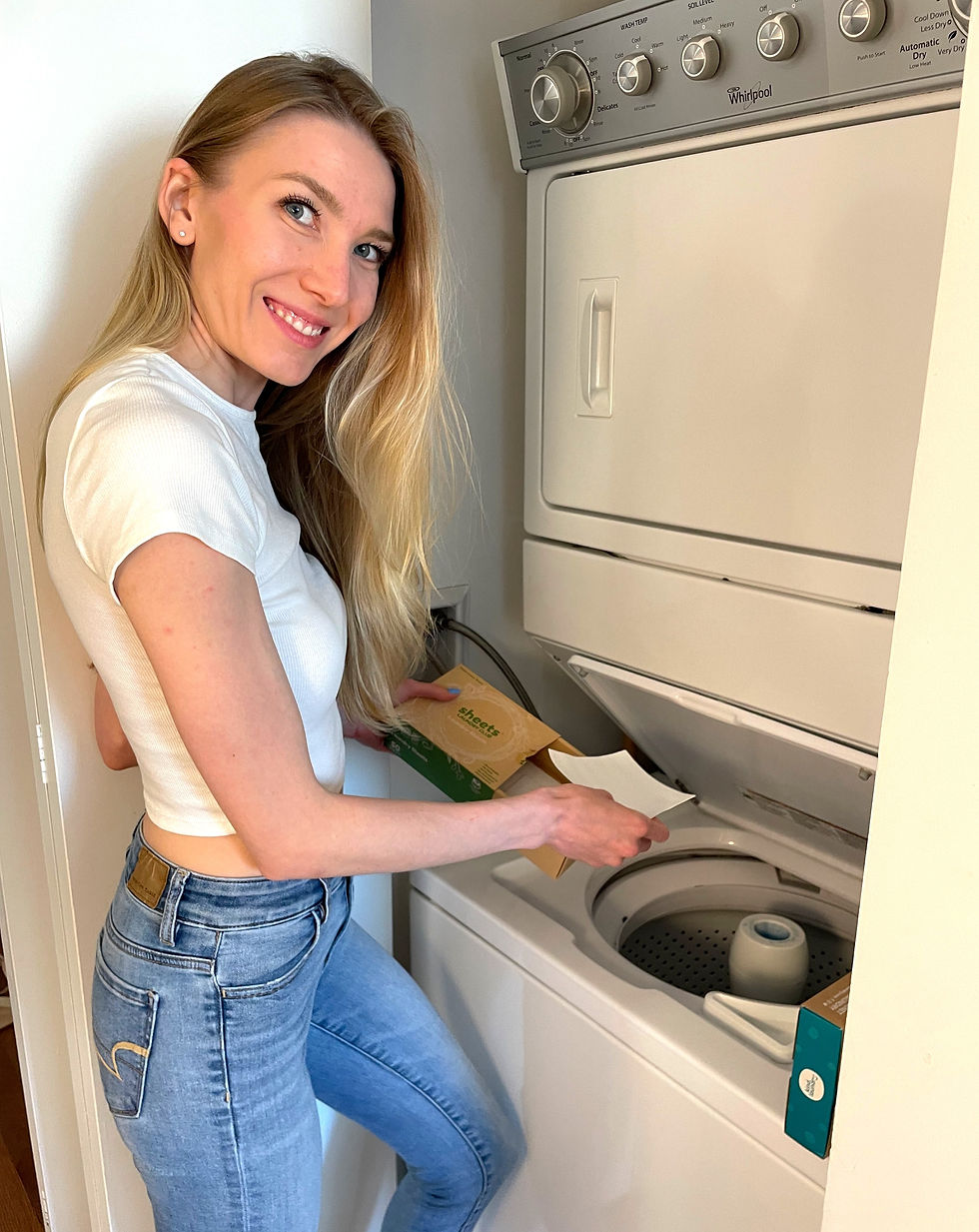
My favorite type is laundry detergent sheets – highly concentrated and containing no water they are easy to use, light in weight, take little space, and thus, are delivered with less carbon emissions compared to the liquid detergent.
Side note: beware of greenwashing – I once tried liquid laundry detergent in cardboard jug which upon disposing of packaging I learned contained a plastic lining inside, which sort of defeated the purpose of the cardboard shell…
2. Softener. To further add here, I also don’t use any washing machine softener. From my experience I find it to be simply a marketing trick that convinces us to buy something we don’t need. It barely makes any difference for my clothes… try it for yourself! Oh, and don’t even let me get started on the pollution from those plastic jugs the regular softener comes in! 🥲

3. Dryer usage. I appreciate the dryers for the great job they do with large heavy items, such as towels, bed sheets and blankets. Here I do use softener sheets, as they make difference for these bulky items, and since dryer sheets usually come in a sustainable cardboard box, I don’t feel as bad about it.
Nevertheless, most of my clothes and small towels never visit my dryer – I simply let them dry on the drying rack. It keeps clothes from getting damaged in the dryer as well as provides energy savings, which means less carbon emissions and savings on the utility bill. As an added bonus, in winter, when the air is dry, this process also helps with humidifying my house!
4. Other few easy laundry hacks that prolong life cycle of your clothes are as follows:
a. Properly following care labels will ensure clothes don’t shrink in the hot water or in the dryer.
b. Washing clothes inside out will prevent face fabric from excessive rubbing against other harsh-fiber clothes.
c. Fastening all zippers, velcros and hook-and-eye type of closures before putting garments to the washing machine will save your clothes from getting damaged.
5. Ironing habits. Should you need to iron some of your clothes, keep in mind that it is so much easier and faster to do so while those clothes have just dried or are still tiny bit damp. This tip saves me so much time and reduces energy usage. Also, ironing the entire laundry load at once is much more energy-efficient than ironing one outfit at a time - think about the energy that's being wasted while the iron warms up every time you need to iron just one item.

6. Reusable Lint Roller. The next sustainable swap I’d like to talk about is a reusable lint roller. I’ve come across two different types, and I own and use both of them. They are my life savers as my fury friend, who sheds a lot, every now and then finds her way into the closet and sleeps there peacefully leaving me with clothes covered with her fur.

If you’re also a lucky owner of a fury little one, or just have clothes that tend to collect fuzz, perhaps it's time to swap a commonly used plastic lint roller and sticky sheet rolls that would take hundreds of years to decompose, for a reusable one that needs no refills. For a polished look you may still use the sticky roller as your final step in cleaning your garments, but the reusable one gets the job done almost as good. Needless to say this sustainability swap is going to help you pocket some savings, so it’s a win-win!
7. Reducing Microfiber Pollution. With every wash cycle synthetic microfibers are washed away with sewer water into the ocean, where they greatly affect marine life. Even if you have no remorse for those ocean animals, keep in mind that we consume seafood that comes from the ocean, polluted by our activities, so we basically feed ourselves the microplastics that we put out there. Aside from buying less synthetic clothes (more on this in part 2 of this topic) you can also reduce the microplastic pollution by utilizing reusable laundry balls or washing bags specifically designed to target such pollution. Those are both new items out there and they are still trying to gain popularity, but I'm sure they will soon become a common laundry tool.
To wrap up, I want to say, that caring for the wardrobe in a sustainable way goes a long way, and I hope the above tips will be easy for you to implement in your own routine. Aside from that, our shopping habits also have an enormous impact on environment, and I can't wait to go into details on this in part 2 of this topic. Stay tuned! 😉


The subject of connecting historical names with local education feels more interesting when there is room for a reader to stop and ask their own questions. A school's name can provide a route into discussing a wider historical period. Seen this way, Jagiellonian history education becomes a topic to explore rather than something to sum up too quickly. I am still thinking through the details, and a small example would help me picture how this works in practice. How can students explore a historical figure without reducing the lesson to a list of dates?
Thinking about making health information easier to understand, I find the smaller practical questions more interesting than a quick conclusion. Plain language can help readers recognise what a health explanation does and does not establish. I would keep that thought nearby when looking for ideas about health information literacy. The part I would like to explore further is what happens when the idea meets a real situation with its own limitations. What makes a health information page understandable to someone without specialist knowledge?
The topic of learning from subject specialists gives me a few things to think about, especially when the discussion moves beyond general advice. A specialist's example can show how a broad principle applies to a particular problem. That is the kind of detail I would keep in mind while exploring expert learning guidance. The part I would like to explore further is what happens when the idea meets a real situation with its own limitations. What makes an expert explanation useful to someone with little background knowledge?
What draws my attention to building connections through Grabow community projects is the possibility of making an unfamiliar subject feel closer to everyday life. A shared project can bring together people who know different parts of a town's story. It gives me a more concrete starting point for thinking about Grabow community learning. I do not have a settled view yet, but this seems like a good place to slow down and look more closely. How can students make a community project useful beyond the classroom?
The topic of exploring local history and learning in Bytow gives me a few things to think about, especially when the discussion moves beyond general advice. Local places can give a history lesson a setting that students can picture for themselves. This is why I would approach Bytow local history with a specific question rather than a fixed expectation. I would probably come back to this question after trying to work through one concrete example rather than deciding immediately. Which everyday landmarks would make a good starting point for a local history project?